Why Timing Matters for Australia
The global nuclear landscape is undergoing a dynamic resurgence, creating new opportunities across energy, technology, and resource sectors. After two decades of stagnation, nuclear power capacity worldwide is projected to increase by at least one-third by 2035. More than 40 countries now include nuclear energy in their strategies, with over 70 GWe of new capacity already under construction, the highest level in 30 years, according to the International Energy Agency (IEA) and the International Atomic Energy Agency (IAEA).
At the recent World Nuclear Exhibition (WNE) 2025 in Paris (4–6 November 2025) drew a large contingent of government agencies and international organizations, underlining nuclear energy’s rising prominence on the global stage. A high-level Ministerial Session on opening day featured officials like IAEA Director General Rafael Grossi and energy ministers from countries such as China, France, the U.S and Canada, signaling strong public-sector support. In total, 1,700 VIPs and officials were present among the 36,000+ participants. This broad representation of governments and institutions set the tone for discussions focused on advancing nuclear technology and collaboration.A major theme at WNE 2025 was the promise of advanced reactor designs, especially Small Modular Reactors (SMRs) to reinvigorate the nuclear sector’s future. Industry leaders highlighted how SMRs and other novel designs are expanding the flexibility and appeal of nuclear energy. On the exhibition floor, numerous deals and partnerships underscored this momentum. For example, Italy’s Ansaldo Energia and EDF’s Nuward signed an agreement at WNE to jointly develop and deploy a new SMR, marking a significant step in accelerating Nuward’s program.One striking trend highlighted at WNE 2025 is that interest in nuclear energy is extending beyond traditional electric utilities. Major industries and technology companies – especially in the digital sector – are “knocking at the door of nuclear,” as IAEA’s Grossi described, in what he called an “epochal change.” Data centres, AI companies, and even maritime firms are turning to nuclear power as a direct, efficient energy source for their operations. Industry news around WNE noted that companies like Amazon, Google, and Meta have already announced plans or agreements for nearly 10 GW of new nuclear capacity (mostly via SMRs) to power their future data centres.These are just some of the key global trends that underscore why timing is critical for Australian industry to start thinking about nuclear-aligned supply opportunities. First, major economies are investing heavily in nuclear as part of their clean energy transition and energy security strategies. The United States has set ambitious goals (aiming for 400 GW of nuclear capacity by 2050), well published on the White House webpage, by presidential declaration ordering the reform of the nuclear regulatory commission to mobilise unprecedented capital, including a partnership that attracted USD $80+ billion in investment and a $100 billion commitment from Japan for new reactor projects as announced by U.S International Trade Commission.This reflects a broader geopolitical alignment in nuclear development: like-minded countries are collaborating on reactor projects, supply chains, and financing frameworks to accelerate deployment of advanced reactors. Second, nuclear’s role is being reframed as strategic infrastructure for a low-carbon future. At COP30 in 2025, over 30 countries endorsed a goal to triple global nuclear capacity by 2050, according to the World Nuclear Association, and their analysis suggests this is attainable if governments act swiftly on their nuclear targets. Achieving such growth would require robust supply chains and skilled labor – factors that create a window of opportunity for new entrants like Australia. In short, the world is moving quickly, and those nations that position themselves early stand to benefit from the emerging nuclear renaissance.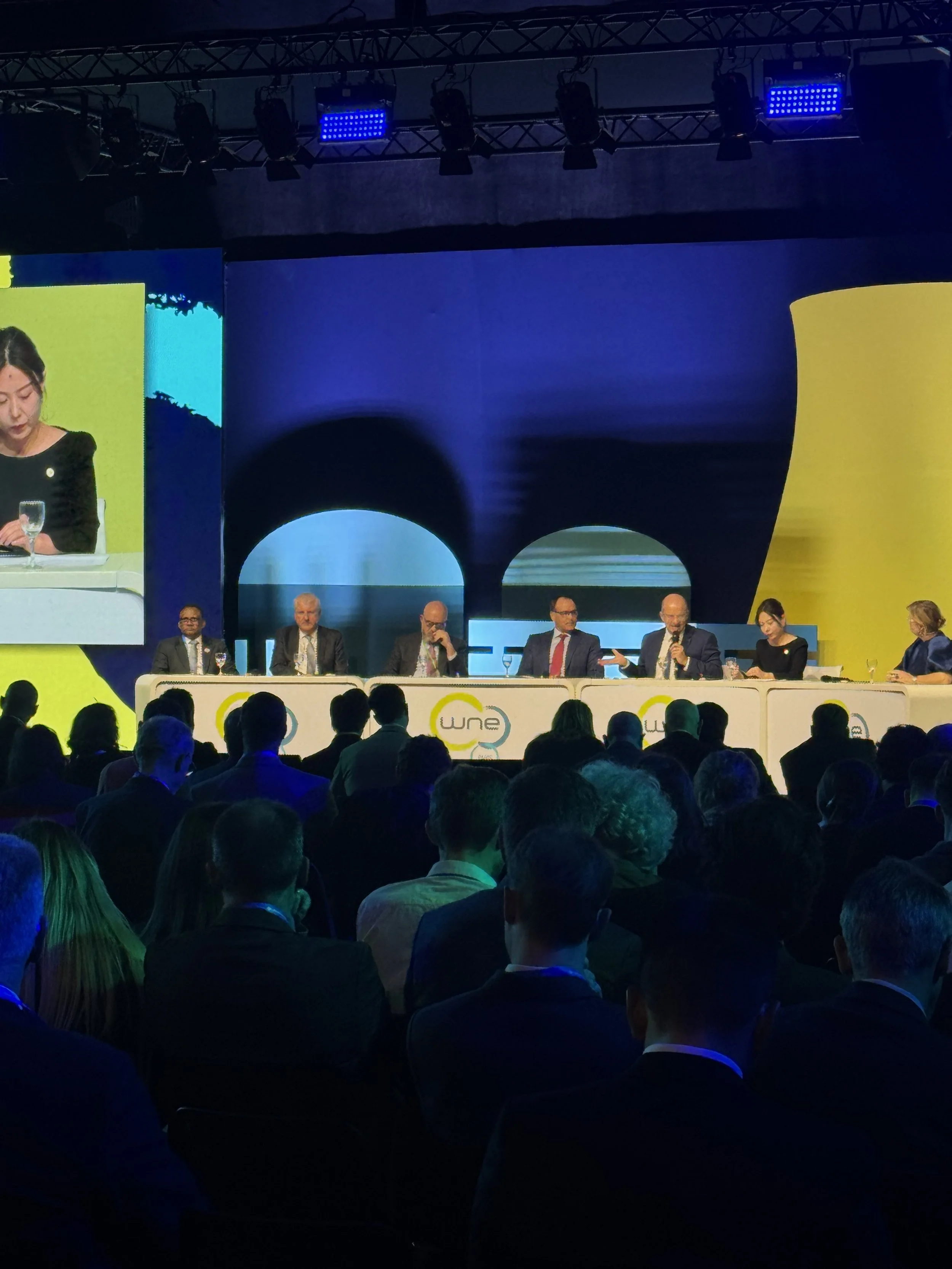
Moderator Linda Nyberg. Speakers: Shudong CAO, Executive Vice Chairman, China Nuclear Energy Association, Christophe Grudler, Member of European Parliament, Xavier Gruz, Group Executive Director EDF, Ian L. Edwards, President Atkins Realis, R Scott Rowe, CEO Flowserve and Arnada Prasad Samal, Chief General Manager, NTPC
Sources and References
International Energy Agency (IEA) — global nuclear capacity projections, reactor construction data, energy security analysis
https://www.iea.orgInternational Atomic Energy Agency (IAEA) — nuclear deployment trends, ministerial statements, SMR development and global nuclear strategy
https://www.iaea.orgWorld Nuclear Association (WNA) — reactor build programs, SMR development, nuclear capacity targets and COP30 commitments
https://www.world-nuclear.orgWorld Nuclear Exhibition (WNE) — official event statistics, attendance figures, ministerial sessions and partnership announcements (Paris, November 2025)
https://www.worldnuclear-exhibition.comEDF / NUWARD — SMR partnership announcements and technology development updates
https://www.edf.fr
https://www.nuward.comAnsaldo Energia — international SMR collaboration announcements and nuclear technology programs
https://www.ansaldoenergia.comUtility Dive — reporting on Big Tech nuclear power agreements for data centres and SMRs
https://www.utilitydive.comReuters — coverage of technology companies’ nuclear energy investments and long-term power purchase agreements
https://www.reuters.comWhite House (United States Government) — U.S. nuclear capacity targets, Nuclear Regulatory Commission reform, energy security initiatives
https://www.whitehouse.govU.S. International Trade Commission (USITC) — reporting on international nuclear investment flows and U.S.–Japan nuclear commitments
https://www.usitc.govCOP30 – Global Climate Action Agenda — nuclear capacity commitments and decarbonisation strategies (Belém, 2025)
https://www.unfccc.intWorld Nuclear News — international reporting on nuclear expansion, SMR investment and global policy alignment
https://www.world-nuclear-news.org