Australia’s Nuclear Ambitions: Building the Industry and Workforce to Compete Globally
Australia’s ability to contribute to and benefit from a booming global nuclear industry will depend on a clear-eyed appraisal of our strengths and weaknesses.
In an era when our allies and economic peers are racing ahead with advanced reactors and nuclear technologies, Australia cannot afford to be left behind. The nation must leverage its unique assets while urgently addressing critical gaps in skills and capacity. Doing so will require a unified effort across government, industry and academia – an effort already being fostered through new collaborative networks such as the Australian Nuclear Workforce & Industry Network (ANWIN). By working together, Australia can build an industrial and workforce framework that keeps us competitive on the world stage. For Australia, this represents one of the most consequential industrial opportunities of the coming decades. While Australia does not operate nuclear power plants, global analysis increasingly identifies materials supply, fuel-cycle capacity and industrial throughput as the binding constraints on nuclear expansion.
Key Assets and Advantages
Australia starts with notable advantages that could underpin a competitive role in nuclear-aligned sectors. These strengths provide a strong foundation for future industry growth:
Rich Resource Endowment: Australia is exceptionally well-endowed with minerals vital to the nuclear supply chain. We hold about 28% of the world’s known uranium reserves, the largest of any country, and are among the top global exporters of uranium oxide fuel. This means Australia’s uranium fuels a significant amount of clean energy generation abroad. Beyond uranium, Australia’s geology also provides abundant critical minerals needed for modern reactors – including zirconium (for nuclear fuel cladding), hafnium, rare earth elements, lithium and cobalt. With a stable, sophisticated mining sector, Australia is uniquely positioned to be a reliable supplier of nuclear materials as global demand rises.
World-Class Research Infrastructure: Even without any domestic nuclear power plants, Australia boasts a strong scientific base in nuclear technology. The Australian Nuclear Science and Technology Organisation (ANSTO) operates the OPAL research reactor at Lucas Heights – a state-of-the-art 20 MW multi-purpose reactor that is widely regarded as among the best research reactors in the world. OPAL typically runs around 300 days per year at full power, producing a range of medical and industrial isotopes. Thanks to this capacity, Australia is on track to supply up to 25% of the world’s molybdenum-99 (Mo-99) – a crucial medical isotope used in millions of diagnostic procedures – once ANSTO’s new production facility ramps up. world-nuclear-news.org. These research and production capabilities are significant national assets, demonstrating Australian expertise in reactor operations, radiochemistry and nuclear safety that is respected internationally
Highly Skilled Allied Workforce: Australia may not yet have a large cohort of nuclear engineers, but our workforce is highly skilled in many adjacent industries. We have deep expertise in mining engineering, conventional power generation, advanced manufacturing, and robotics – all of which are transferable to nuclear projects. Australian universities graduate top-notch talent in physics, chemistry, engineering and materials science. There is already a pool of specialists working in radiation safety, reactor science and nuclear medicine (for example, at ANSTO and major hospitals). This provides a solid foundation to upskill and cross-train personnel into nuclear roles. Moreover, as an English-speaking OECD nation with close ties to the US and UK, Australia finds it easier to exchange know-how and personnel with established nuclear countries. (Under the AUKUS security partnership, for instance, Australian engineers and Navy personnel are being placed in US and UK nuclear facilities to gain direct experience.) These linkages mean our skilled people can rapidly absorb world best practices – a crucial advantage as we build a domestic nuclear workforce.
Robust Safety and Regulatory Framework: Decades of handling nuclear materials – from uranium mines through research reactors to medical isotope production have given Australia a well-established safety and regulatory regime. Agencies like ARPANSA (the Australian Radiation Protection and Nuclear Safety Agency) have developed rigorous standards and a safety culture around radioactive materials. Even without commercial nuclear energy, Australia has successfully operated nuclear research facilities and managed radioactive waste on a small scale under strict regulation. This experience is a valuable asset: establishing a safety culture and regulatory expertise is often a major hurdle for newcomer countries in nuclear energy. Australia’s strong governance, transparency and public sector capability mean that we already have a baseline to build on for any future nuclear projects. Our reputation for high safety standards can enhance Australia’s attractiveness as a partner or host nation for nuclear ventures (for example, collaborating on fuel cycle research or hosting international nuclear training exercises).
Global Partnerships and Alliances: Strategically, Australia is aligned with major nuclear-capable allies, and we are actively plugged into international nuclear forums. We have a seat on the IAEA Board of Governors and participate in global nuclear safety and research initiatives. Most notably, the AUKUS pact with the United States and the United Kingdom is giving Australia access to allied expertise in nuclear propulsion and engineering. Through AUKUS, Australian personnel are training abroad and embedding in US/UK programs to develop skills in nuclear submarine operations. Such partnerships are opening doors for Australian industry as well. Being part of trusted alliance networks means Australian companies can more readily join multinational supply chains – for example, supplying components or services into US and UK reactor projects – thereby integrating into the global nuclear ecosystem. These ties and our credibility as a partner help position Australia to leapfrog ahead by leveraging the know-how of our friends.
Capability Gaps and Challenges
On the other side of the ledger, Australia faces significant gaps that must be filled to meet the demands of advanced nuclear projects. Recognising these shortfalls is the first step to overcoming them:
Limited Nuclear Workforce at Home:
Because Australia has not had a commercial nuclear power sector, our pool of nuclear-trained professionals is very small. We have only a few hundred at most specialised nuclear engineers, reactor physicists and technicians, and most are clustered in research or medical roles.
In contrast, a full-fledged nuclear energy program would require tens of thousands of highly skilled workers. One analysis found that introducing a sizeable civilian nuclear power industry (on the order of 50 GW capacity by 2050) could create up to 55,000 jobs by mid-century – a rough proxy for the workforce scale needed. Even more modest nuclear projects will demand specialised skills that are currently scarce here, so we have to start establishing pathways abroad for upskilling and educating, whilst simultaneously building programs locally. For example, the planned AUKUS submarine program will require over 8,000 people with some form of nuclear training just to crew and maintain the new submarines. Australia simply does not yet have those numbers of nuclear-savvy workers. Bridging this skills gap will require a monumental workforce development effort: nurturing new nuclear engineers through university programs, reskilling professionals from other industries, and attracting talent from abroad. Importantly, this ramp-up takes time, on the order of decades, so we must start investing in people now.
Nascent Industrial Base for Nuclear Projects:
Australia’s heavy industry and manufacturing sector currently lacks experience with nuclear-grade construction and fabrication. We have never built a commercial nuclear power plant or a naval reactor, which means we do not have the established factories or supply chains for key components. Facilities like heavy forging presses for reactor pressure vessels, specialised welding and machining shops for nuclear materials, or fuel fabrication plants are absent domestically. Moreover, few Australian manufacturers today are qualified to the extremely high standards required for nuclear equipment (the stringent QA and safety requirements known as “nuclear grade” manufacturing). Building this industrial capability will be a major challenge. It will likely require investment in new infrastructure – for instance, setting up module assembly yards if we pursue small modular reactors (SMRs), or partnering with experienced overseas vendors to transfer technology for component manufacturing. Without developing a local nuclear supply chain, Australia would remain almost entirely dependent on imports for reactor technology and parts, raising costs and strategic risks. Nurturing a home-grown nuclear industry (even if focused on specific niches offshore, accommodating global markets) is therefore critical for long-term self-reliance.
Regulatory and Legal Barriers:
A well-known hurdle is Australia’s current ban on domestic nuclear power, which is enshrined in federal law. The Australian Environmental Protection and Biodiversity Conservation (EPBC) Act 1999, along with several state laws, prohibits the construction of nuclear power reactors for electricity. This long-standing moratorium means Australia has no established licensing process or regulatory framework for commercial nuclear energy. While our nuclear regulator is experienced with research facilities, scaling up to oversee full-scale power reactors would require new legislation, new regulations and a larger regulatory workforce. Encouragingly, there are signs of movement on this front: in late 2025, a private Senator’s bill was introduced in Parliament seeking to lift the moratorium and allow nuclear energy to be considered on its merits. If and when such legal barriers fall, Australia will need to move quickly to put a robust regulatory regime in place.
Additionally, there is the challenge of public acceptance. Nuclear projects in Australia have historically met with public scepticism or opposition, stemming from safety and environmental concerns. Earning public trust – securing a “social license” – will be vital.
Lack of Operational Experience:
Running nuclear facilities, whether power plants, research reactors, or nuclear submarines, demands a depth of operational experience that Australia has yet to develop. We have never had to manage the full life-cycle of a large nuclear system: tasks like integrating a nuclear plant into the electrical grid, handling spent nuclear fuel and radioactive waste at scale, or decommissioning an old reactor are all new to us. The organisational knowledge and “nuclear culture” that comes from decades of operating reactors is something you simply cannot buy off-the-shelf. Countries with established nuclear industries often have generations of engineers and tradespeople who have worked on reactors and learned from mistakes and improvements over time. Australia will need to acquire as much of this know-how as possible through international cooperation. In the interim, we are leveraging our allies’ experience – for example, as mentioned, Australian naval and industry personnel are being embedded in US and UK nuclear programs to soak up operational expertise and training. We are also likely to hire overseas experts and consultants in the early stages of any major project. While these measures help, they are no substitute for developing our own long-term operational talent. The lack of a track record will be a vulnerability in the early years of any nuclear initiative, meaning we must plan for a cautious, well-supervised entry into the field. Over time, with the right partnerships and by “learning by doing” on pilot projects, Australia can accumulate the experience needed – but this will be an evolving challenge for years to come.
A Unified Strategy to Move Forward
Positioning Australia for success in the global nuclear ecosystem will require a two-pronged strategy: leverage our strengths to carve out roles where we can lead or add value immediately, while systematically closing the gaps that have held us back. In practice, this means leveraging our comparative advantages in the near term, while laying the groundwork for deeper involvement in the long term. In the immediate future, Australia can focus on what it already does well in the nuclear domain. That includes supplying raw materials and specialised products to the global market – for instance, exporting uranium oxide to friendly nations’ reactor fleets, scaling up production of medical isotopes like Mo-99, and providing critical minerals for advanced reactor designs. We can also contribute to international R&D efforts: Australian labs and universities can partner on nuclear research projects, innovation in reactor materials, waste management techniques (such as ANSTO’s Synroc technology), and so on. These are areas where Australia adds value today, without needing a fully developed domestic reactor industry. At the same time, we must invest aggressively in building the capabilities we lack. This entails launching and expanding nuclear engineering education programs (several Australian universities are now exploring new courses and overseas exchange programs in response to AUKUS). It means funding scholarships, apprenticeships and on-the-job training pipelines to produce the engineers, technicians and safety professionals of the future. Some of this is already underway; for example, the federal government has announced hundreds of new STEM university places and vocational training spots tied to the submarine program.
Industry groups and networks, such as ANWIN, are poised to coordinate many of these efforts, connecting companies with training providers and experts abroad. Likewise, Australian firms are starting to sign cooperation agreements with established nuclear companies overseas, gaining access to technology and mentorship that can help them become “nuclear-qualified” suppliers over time.
And on the policy front, there’s growing momentum to update our legislative and regulatory framework, with inquiries and task forces examining how to modernise our laws, and how to safely introduce technologies. Perhaps most importantly, Australia’s budding nuclear initiative will require a sense of common purpose and collaboration across traditional sector lines. It’s not just a government project, or just an industry initiative – it has to be both, with academia and the public on board as well. Building a nuclear workforce and industry is a whole-of-nation undertaking, much like our past national projects (the Snowy Mountains Scheme, for example, or the space tracking program).
In the coming decade, Australia has the chance to move from a peripheral player to a core contributor in the global nuclear ecosystem. We have the resources, we have the talent, and we have trustworthy partners. With a clear strategy to marshal these strengths – and a commitment to address our deficits through investment and reform – Australia can secure its place at the table. The stakes are high: the countries that build the industries and workforces of the future will reap the economic and strategic rewards. By acting with unity and vision now, Australia can ensure it is among them, and that our nuclear future is one of both national benefit and global relevance.
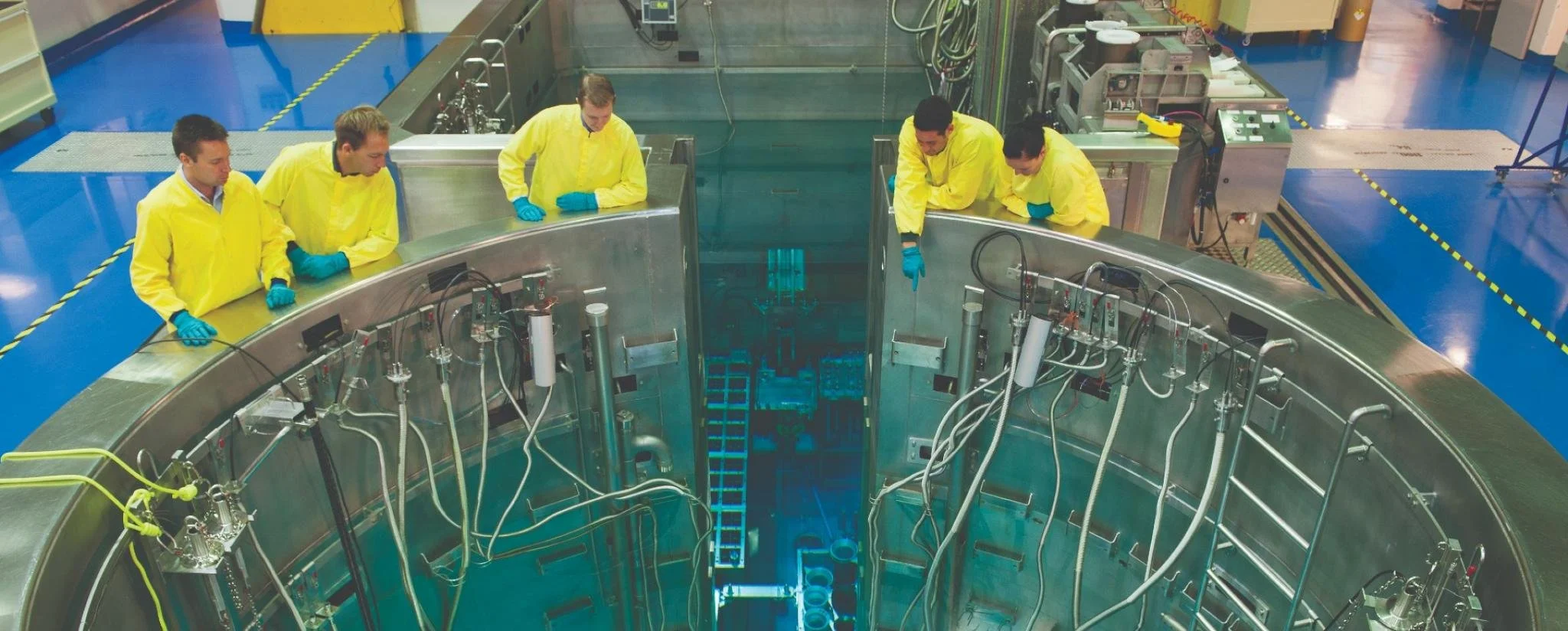
Technicians works inside the OPAL research reactor vessel, Australia’s only nuclear reactor at ANSTO
Sources and References
International Energy Agency (IEA) — global nuclear expansion, fuel-cycle constraints and industrial throughput
https://www.iea.orgWorld Nuclear Association (WNA) — uranium reserves, reactor deployment, workforce needs and nuclear fuel markets
https://www.world-nuclear.orgOECD Nuclear Energy Agency (NEA) — nuclear workforce requirements, industrial capacity gaps and supply-chain readiness
https://www.oecd-nea.orgInternational Atomic Energy Agency (IAEA) — nuclear governance, safety culture, fuel-cycle participation and international best practice
https://www.iaea.orgGeoscience Australia — uranium, zirconium and critical minerals reserves and production data
https://www.ga.gov.auMinerals Council of Australia — uranium sector outlook, critical minerals strategy and global energy supply chains
https://www.minerals.org.auAustralian Nuclear Science and Technology Organisation (ANSTO) — OPAL research reactor performance, isotope production, Synroc technology and nuclear science capability
https://www.ansto.gov.auWorld Nuclear News — reporting on OPAL reactor, Mo-99 production, research reactors and global nuclear workforce trends
https://www.world-nuclear-news.orgAustralian Radiation Protection and Nuclear Safety Agency (ARPANSA) — nuclear safety regulation, radiation protection frameworks and licensing experience
https://www.arpansa.gov.auAustralian Submarine Agency (ASA) — nuclear workforce development, training pathways and nuclear stewardship capability under AUKUS
https://www.asa.gov.auAustralian Government – Department of Defence / Minister for Defence — AUKUS nuclear submarine workforce requirements, training numbers and international embedding programs
https://www.minister.defence.gov.auAustralian Government – Department of Industry, Science and Resources — STEM workforce initiatives, critical minerals strategy and industrial capability development
https://www.industry.gov.auAustralian Government – Department of Education — STEM education pipeline and workforce planning
https://www.education.gov.auAustralian Parliament / EPBC Act 1999 — legislative framework governing nuclear energy in Australia
https://www.legislation.gov.auAustralian Parliamentary inquiries and private members’ bills (2025) — proposed reforms to nuclear energy prohibitions
https://www.aph.gov.auAUKUS Partnership (Australia–UK–US) — nuclear propulsion collaboration, workforce exchanges and industrial integration
https://www.defence.gov.au/aukusOECD — industrial policy, trusted supply chains and governance frameworks in strategic sectors
https://www.oecd.org