Tech Industry’s Nuclear Shift – An “Epochal Change”
The nuclear energy landscape is undergoing what IAEA Director General Rafael Grossi calls an “epochal change,” as demand extends beyond traditional electric utilities to new tech sectors. Major technology and industrial players especially in cloud computing, AI, and high-tech manufacturing are now “knocking at the door of nuclear”, seeking it as a direct, reliable energy source. In Grossi’s words, “the Googles of this world and the Microsofts of this world are now knocking… They are requesting nuclear to deliver”. This marks a pivotal shift: data centres, AI infrastructure, chip fabs, and even maritime and heavy industries are exploring nuclear power for round-the-clock, carbon-free electricity. Speakers at the World Nuclear Exhibition (WNE) 2025 noted this trend as a new growth driver for nuclear, broadening its market far beyond the utility sector.Big Tech’s Deals for 24/7 Clean Energy
One S&P Global study estimated data centres alone could drive 35 GW of additional power demand by 2030.Hyperscale data centres and AI supercomputing clusters consume enormous energy, pushing tech giants to secure new clean power sources. In the past two years, several flagship agreements signal Big Tech’s nuclear turn:Amazon: The cloud leader has invested in X-energy and plans to deploy up to 5 GW of small modular reactor (SMR) capacity in the U.S. by the 2030. Amazon led a $500 million funding round in X-energy and inked deals to install four 80 MW SMRs (320 MW total) with Energy Northwest by the early 2030s, with options to expand to 960 MW. Amazon also signed an MoU with Dominion Energy to explore SMR projects in Virginia, and has collocated an AWS data centre next to Talen Energy’s Susquehanna nuclear plant in Pennsylvania. The goal is clear – Amazon sees nuclear as “carbon-free and able to scale,” a key to powering its cloud and even electrified logistics operations for decades ahead.Google: In October 2024, Google became the first tech company to commission new nuclear plants for its needs, signing a deal with Kairos Power to build a fleet of advanced reactors totalling 500 MW by 2035. The first unit is expected online by 2030, and Google will purchase the energy and environmental attributes under a 25-year agreement. Further, Google has actively supported preserving existing nuclear capacity: it recently signed a 25-year PPA to revive NextEra’s 600 MW Duane Arnold nuclear plant in Iowa. Google’s Head of Energy said the company backs “new builds of [existing] reactors, as well as uprates and life extensions of [the] fleet”, viewing nuclear as critical to its 24/7 carbon-free goals. Google even inked a partnership in 2025 with Commonwealth Fusion Systems – including a 200 MW fusion energy purchase agreement in the 2030s – reflecting a long-term bet on advanced nuclear innovations.Microsoft: Microsoft has taken a bold step by leveraging nuclear to power its cloud. In late 2024 it announced a 20-year PPA with Constellation Energy to restart the dormant Three Mile Island Unit 1 reactor (835 MW) to supply its data centres by 2028. This would be the first-ever restart of a retired U.S. nuclear unit specifically for a data centre customer. Microsoft is also partnering with Google and others in an Advanced Clean Electricity initiative to spur investment in firm power like advanced reactors.Meta (Facebook): In December 2024, Meta openly solicited nuclear energy suppliers, a Request for Proposals for 1 GW to 4 GW of new nuclear capacity to begin serving its U.S. data centres in the early 2030s. Meta’s RFP invites both SMRs and traditional large reactors, emphasizing partners with community engagement and permitting expertise. The company framed this as essential for its AI and sustainability objectives, noting nuclear’s 24/7 reliability is “a key requirement of data centres” and a complement to renewables. Since issuing the RFP, Meta has been in talks with utilities interested in new nuclear but “nervous” to go it alone – hinting that innovative utility–tech collaborations may emerge. Notably, even before new-build nuclear is ready, Meta signed a recent 20-year deal to buy power from Exelon’s Clinton nuclear plant to help run its AI workloads, signalling immediate action toward nuclear-sourced power.Oracle: Oracle’s CTO Larry Ellison said the company already obtained permits for three SMRs to power a new cloud data centre.
Chips and Quantum Computing – Energy Hunger Meets Nuclear Potential
It’s not just data centres, semiconductor manufacturing and advanced computing are also grappling with power needs that nuclear could uniquely fill. Chip fabrication plants (fabs) are extremely energy-intensive; for example, Taiwan’s TSMC (the world’s top chipmaker) is projected to consume as much electricity by 2030 as a quarter of Taiwan’s 23 million people. Taiwan’s government recently lifted a legal barrier to let reactors run longer, a sign of how critical steady power will be, as countries jungle with renewables and energy baseloads. In the United States, new semiconductor mega-factories are on the way (spurred by the CHIPS Act), and planners are eyeing nuclear options aspart of the sustainable outputs. In Ohio, home to Intel’s upcoming chip campus, energy developers have floated SMR-powered data centres near the Silicon Heartland tech corridor. Similarly, the first advanced reactor project by X-energy is actually planned at a Dow chemical plant in Texas – showing nuclear’s appeal for powering industrial processes that demand both electricity and high-temperature heat. The common thread is scale and reliability: whether it’s an AI supercluster churning through data or a chip fab running 24/7 lithography tools, these loads can reach the hundreds of megawatts and cannot go down without severe economic loss. Nuclear reactors – especially SMRs with factory-built components and inherent stability – offer an attractive solution. They provide “clean, safe, and reliable electrons… that can scale and grow with demand,” as X-energy’s CEO Clay Sell put it. Unlike solar or wind, a nuclear unit can deliver full power around the clock, and new designs promise deployment flexibility (e.g. X-energy’s reactor is modular in 80 MW increments and “road-shippable” for easier construction. JPMorgan analysts have even dubbed SMRs the “ultimate solution” for powering AI, projecting that AI data growth will double uranium consumption and drive a new wave of reactor orders.Importantly, heavy industries outside of tech are following suit. Grossi notes steelmakers, shipping lines, and even legacy coal utilities are now exploring nuclear options to decarbonise operations. For example, Nucor (a major steel company) joined with tech firms in a novel clean energy tariff program to support SMR development. These cross-sector initiatives indicate that advanced nuclear is becoming part of a broader high-tech ecosystem – one where “atoms for algorithms” (as Grossi quipped) could underpin the digital economy’s growth with firm, clean energy.Opportunities and Implications for Australia
Australia, despite having no domestic nuclear power plants, finds itself strategically positioned in this emerging tech-nuclear nexus. As a major exporter of uranium and critical minerals, Australia stands to benefit from the global reactor build-out fuelled by AI and data centre demand. Uranium miners note that SMR deployments could significantly boost uranium consumption, tightening a market already in supply deficit. Beyond exporting raw materials, Australia has the capacity to participate further along the nuclear value chain. Through AUKUS, Australia is developing nuclear stewardship capability, regulatory maturity and workforce expertise associated with nuclear-powered systems in partnership with the United States and the United Kingdom. This capability base — while defence-led — contributes to broader national competence in nuclear standards, safety, engineering and systems integration.Irrespective of whether Australia deploys civilian nuclear power domestically, global experience demonstrates that countries can design, manufacture, supply and service nuclear-aligned technologies internationally without operating reactors at home. Participation in the nuclear ecosystem is therefore not binary; it spans materials, components, engineering services, regulatory expertise, digital systems and workforce capability.This is where ANWIN plays a defining role. By engaging Australian industry, mapping transferable capability and connecting organisations into global nuclear-aligned supply chains, ANWIN is working to ensure Australia is positioned not merely as a materials exporter, but as a credible, informed and coordinated participant in the advanced nuclear and technology ecosystems now forming globally because, the convergence of AI, big data, and nuclear innovation is a game-changer. Partnering with established nuclear players and tech companies will be crucial.
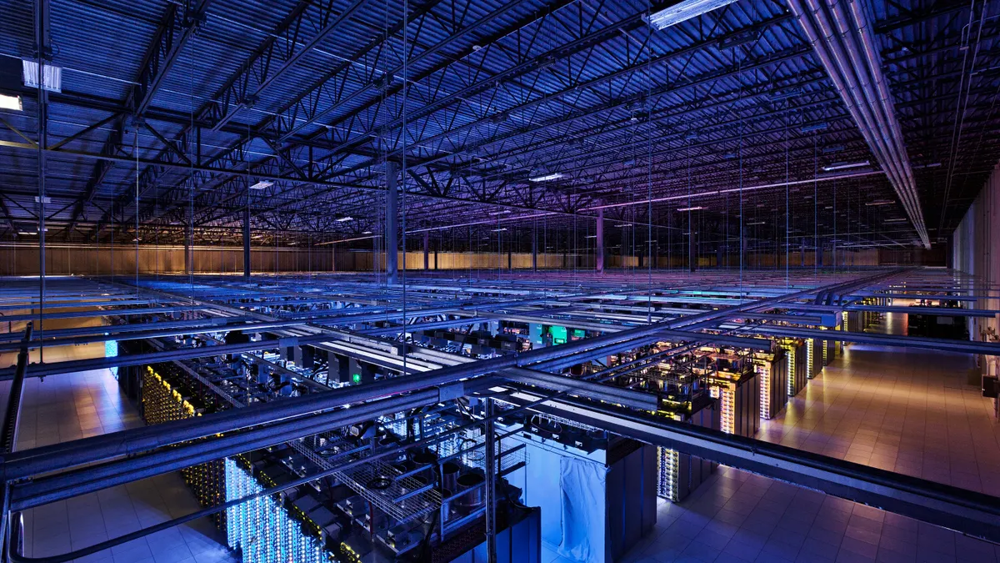
GOOGLE data center
Sources and References
Tech Industry’s Nuclear Shift – An “Epochal Change”
International Atomic Energy Agency (IAEA) — statements by Director General Rafael Grossi on non-utility demand, SMRs and nuclear’s role in the digital economy
https://www.iaea.orgWorld Nuclear Exhibition (WNE) — conference proceedings, speaker commentary and partnership announcements (Paris, November 2025)
https://www.worldnuclear-exhibition.comReuters — reporting on Big Tech nuclear power agreements, data centres and reactor restarts
https://www.reuters.comUtility Dive — coverage of Amazon, Google, Meta and Microsoft nuclear power procurement and SMR partnerships
https://www.utilitydive.comS&P Global — analysis of data-centre electricity demand growth and implications for power systems
https://www.spglobal.comAmazon Web Services (AWS) — investment announcements with X-energy, Energy Northwest and Dominion Energy; data-centre power strategy
https://www.aboutamazon.comX-energy — SMR technology development, Amazon investment details and industrial deployment plans
https://www.x-energy.comGoogle — nuclear power purchase agreements with Kairos Power; 24/7 carbon-free energy strategy
https://www.blog.googleKairos Power — advanced reactor development and long-term supply agreements with Google
https://kairospower.comMicrosoft / Constellation Energy — Three Mile Island Unit 1 restart agreement and long-term nuclear PPA
https://www.microsoft.com
https://www.constellationenergy.comMeta (Facebook) — RFP for 1–4 GW of nuclear power for data centres; long-term clean-energy strategy
https://about.meta.comOracle — statements by CTO Larry Ellison regarding SMRs for data-centre power
https://www.oracle.comJPMorgan — analyst commentary on AI-driven electricity demand, SMRs and uranium market impacts
https://www.jpmorgan.comTSMC — semiconductor manufacturing energy demand and national power considerations
https://www.tsmc.comU.S. Department of Energy (DOE) — nuclear energy’s role in advanced manufacturing, AI and industrial decarbonisation
https://www.energy.govDow / X-energy — SMR deployment at industrial chemical facilities
https://corporate.dow.comWorld Nuclear Association (WNA) — SMRs, uranium demand growth and non-utility nuclear markets
https://www.world-nuclear.orgAustralian Government – Department of Industry, Science and Resources — critical minerals and uranium market context
https://www.industry.gov.auAustralian Submarine Agency (ASA) — nuclear stewardship capability development under AUKUS
https://www.asa.gov.au